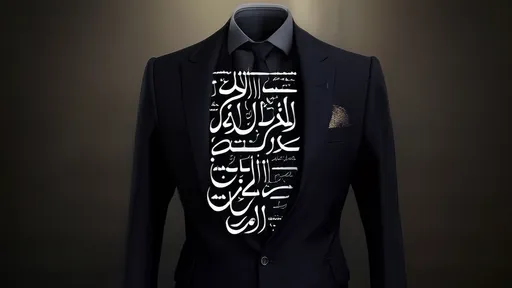
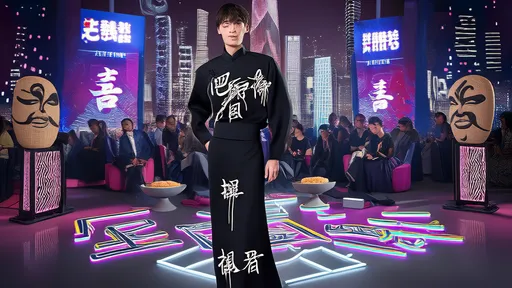
The intersection of traditional Islamic art and contemporary fashion has birthed one of the most visually striking sartorial movements in recent memory - the Persian calligraphy suit. What began as niche experimentation by avant-garde Middle Eastern designers has blossomed into a global phenomenon, with luxury houses from Milan to Dubai incorporating Arabic script deconstructions into their collections. This isn't mere cultural appropriation, but rather a profound dialogue between heritage and modernity.
At its core, the Persian calligraphy suit transforms the sacred art of khatt (Islamic calligraphy) into wearable poetry. The flowing diwani script, angular kufic letterforms, and lyrical nastaliq strokes that once graced Quranic manuscripts and mosque walls now dance across lapels and trouser legs. Designers don't simply print words onto fabric - they deconstruct, fragment, and reimagine the very essence of Arabic writing systems.
The process begins with master calligraphers, often trained in traditional methods dating back to the Abbasid era. Using bamboo or reed pens, they create original compositions ranging from classical poetry verses to contemporary phrases. "We treat each suit as a blank parchment," explains Tehran-based designer Amir Yeganeh, whose atelier collaborates with fourth-generation calligraphers. "The body becomes the canvas, with sleeve seams and jacket darts influencing how we distort the text."
What makes these designs revolutionary is their approach to negative space. Unlike Western typography which prioritizes legibility, Persian calligraphy suits employ tashdid (compression) and tawassu (expansion) techniques to make the script interact with garment structures. A single word might stretch across a back panel, its letters dissolving into abstract shapes near the shoulders only to reform at the waist. This creates an optical illusion where the writing reveals itself differently with each movement.
The color palettes pay homage to historical manuscripts while accommodating modern tastes. Deep indigos recall the dyes used in medieval Persian books, while gold leaf detailing mirrors the illumination of religious texts. Contemporary iterations experiment with neon gradients and metallic foils, particularly in streetwear-inspired pieces that remix calligraphy with graffiti aesthetics.
Cultural historians note the trend's significance beyond fashion. "For centuries, Arabic script was confined to religious and bureaucratic contexts," says Dr. Leila Farahani of the Islamic Arts Museum Malaysia. "By transforming it into wearable art, designers are democratizing a visual language while preserving its spiritual essence." This duality manifests in subtle details - hidden blessings woven into lining patterns, or Suras positioned to align with the wearer's heartbeat.
The technical challenges are immense. Traditional calligraphy relies on precise ink absorption that fabric can't replicate. Designers developed specialized digital printing techniques that mimic the organic bleed of ink on paper, sometimes incorporating actual calligraphy scans treated with algorithmic distortion. Italian fabric mills have created custom jacquards that emulate the texture of parchment when woven with silk-cotton blends.
Critics initially dismissed the trend as exoticism, but the craftsmanship silenced skeptics. A single suit from Beirut's House of Barakat might involve six artisans: a calligrapher, a pattern engineer who maps the text to garment pieces, a dye specialist, an embroiderer for goldwork, a tailor for structural integrity, and a quality controller ensuring the design reads coherently when worn. The result blurs boundaries between clothing and art object.
Street style photography reveals how wearers personalize the look. Some pair sharply tailored calligraphy blazers with distressed denim, while others commit to full thematic ensembles with matching script-printed accessories. The trend has particularly resonated with diaspora communities, serving as both cultural statement and sartorial flex. London-based stylist Yasmin El-Safadi notes, "My clients use these pieces to reconnect with heritage in an organic way - the writing becomes conversation starters about shared histories."
High-profile moments have propelled the trend into mainstream consciousness. At the 2022 Venice Biennale, performance artist Tarek Al-Ghoussein staged a live calligraphy session where models' suits were painted throughout the event. Music icons like Elissa and Ramy Youssef have worn custom pieces featuring lyrics from their songs rendered in thuluth script. Even corporate culture has embraced subtle iterations, with Dubai financial firms adopting pinstripe suits where the stripes are microscopic Arabic numerals.
The movement continues evolving through technological cross-pollination. A Jordanian startup recently launched an app that converts voice recordings into calligraphic patterns for bespoke printing. Meanwhile, heritage brands like Niswa are reviving ancient dye techniques using pomegranate peel and saffron to create historically authentic colorways for their script designs.
Perhaps most remarkably, the Persian calligraphy suit has become a bridge between cultures. Non-Arabic speakers frequently wear designs whose meanings they don't comprehend, drawn purely to the visual rhythm. This mirrors how many appreciate Chinese characters or Celtic knots as pure aesthetics. The phenomenon raises fascinating questions about language, semiotics, and what happens when written words transcend their literal meaning to become universal art.
As the trend matures, purists and innovators continue debating its boundaries. Traditionalists insist on hand-drawn compositions and natural dyes, while avant-gardists experiment with 3D-printed letters and augmented reality overlays that make the script "dance" via smartphone. What unites all approaches is reverence for the letterforms themselves - whether faithfully reproduced or radically reimagined, the Arabic script remains the undisputed protagonist of this sartorial revolution.
The future may see even deeper fusions. Prototype "smart suits" with pressure-sensitive inks change their calligraphic displays based on the wearer's movements. Sustainable designers are experimenting with algae-based dyes that gradually evolve the script's color over time, mimicking manuscript aging. One visionary project even proposes embedding microchips that recite the poetry printed on garments when scanned.
Ultimately, Persian calligraphy suits represent more than a fashion statement. They're a living dialogue between past and present, between sacred traditions and contemporary expression. As wearers don these mobile canvases, they become walking testaments to the enduring power of written beauty - each stitch and stroke carrying forward a cultural legacy while inscribing new chapters in the story of Islamic art.
The fashion industry has long been at the forefront of innovation, blending creativity with technology to redefine consumer experiences. In a groundbreaking move, the concept of the metaverse has collided with physical retail in what is being hailed as the first case of digital asset materialization—specifically, through the lens of loafers. This isn’t just about virtual sneakers or pixelated handbags; it’s a full-scale integration of blockchain-based ownership and tangible craftsmanship. The "Loafverse" initiative, as it’s been dubbed, is rewriting the rules of how we perceive value, authenticity, and utility in fashion.
The intersection of traditional Islamic art and contemporary fashion has birthed one of the most visually striking sartorial movements in recent memory - the Persian calligraphy suit. What began as niche experimentation by avant-garde Middle Eastern designers has blossomed into a global phenomenon, with luxury houses from Milan to Dubai incorporating Arabic script deconstructions into their collections. This isn't mere cultural appropriation, but rather a profound dialogue between heritage and modernity.
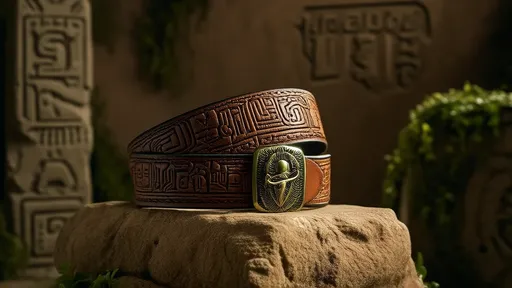
In the heart of ancient Mesoamerica, the Maya civilization crafted a sophisticated calendar system that not only measured time but also encoded their cosmic worldview. Today, this intricate knowledge has found a surprising new form—wearable art. Designers and artisans are transforming the sacred symbols of the Mayan calendar into stunning pieces of jewelry and accessories, merging ancient wisdom with contemporary fashion. These creations, often referred to as "Mayan Calendar Belts," are more than just decorative items; they serve as tangible connections to a lost civilization, inviting wearers to carry a fragment of history with them.
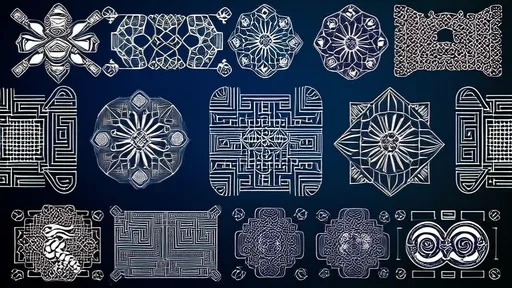
The intricate artistry of Miao silverwork, a centuries-old intangible cultural heritage of China’s Miao ethnic group, is undergoing a quiet revolution. As modern technology intersects with traditional craftsmanship, parametric design has emerged as a powerful tool to preserve, analyze, and innovate upon these delicate metalworking techniques. This fusion of ancient wisdom and computational methods is creating new possibilities for cultural preservation while respecting the essence of the craft.
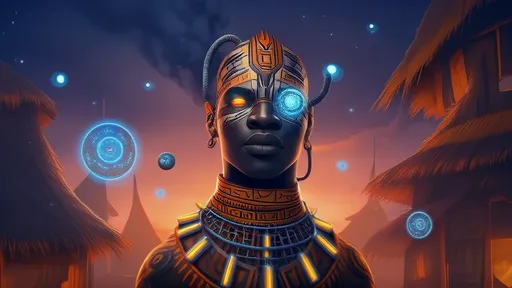
The neon-lit streets of Lagos pulse with a rhythm that defies categorization – a fusion of ancient drumbeats and digital glitches that echoes through the towering megastructures of a reimagined Africa. This is the visual language of Afrofuturist cyber-tribalism, where ancestral wisdom interfaces with quantum computing, and biomechanical deities wear the masks of forgotten gods. Across the continent's creative vanguard, artists are forging a new aesthetic paradigm that dissolves the false dichotomy between tradition and innovation.
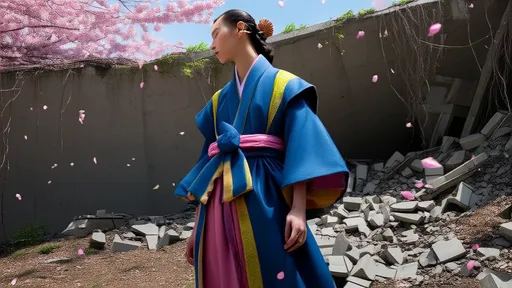
In the quiet corners of Fukushima Prefecture, where cherry blossoms still bloom with fragile resilience, a centuries-old tradition is undergoing a remarkable metamorphosis. The art of kimono-making, once threatened by the triple disaster of earthquake, tsunami, and nuclear crisis in 2011, has emerged as an unexpected symbol of cultural rebirth. Local artisans, many of whom lost everything in the catastrophe, are now collaborating with contemporary designers to transform this emblem of Japanese heritage into wearable art for the global fashion stage.
In the bustling fashion scene of China, where tradition meets modernity, the Chengdu Fashion Week has emerged as a groundbreaking platform for independent designers to showcase their creativity. This year, the event took an unexpected turn as local dialect elements became a defining feature, breaking through cultural and linguistic barriers to captivate a global audience. The fusion of Sichuan’s rich linguistic heritage with contemporary design has not only redefined regional aesthetics but also sparked conversations about identity and authenticity in fashion.
In the realm of fashion, few names evoke as much reverence and intrigue as Saint Laurent. The house’s latest offering, Desert Book, is a testament to the enduring allure of minimalism, reimagined through a lens of poetic subtlety. This collection is not merely a series of garments; it is a narrative woven from the arid landscapes of the desert, where silence speaks louder than words and simplicity becomes a form of profound expression.
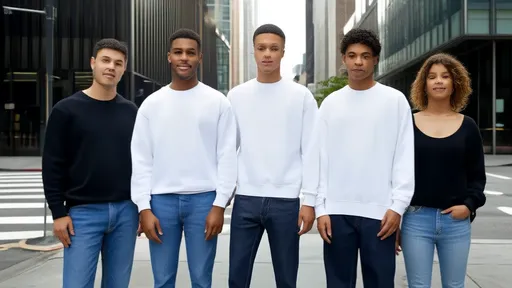
In an era dominated by polished influencer marketing and celebrity endorsements, Uniqlo's "regular people" fashion shows stand out as a deliberate departure from industry norms. The Japanese apparel giant has built a global empire by celebrating the mundane, transforming everyday wear into a cultural phenomenon. Their recent "Uniqlo U" showcase in Tokyo featured not professional models but office workers, students, and retirees - a strategic move that reveals deeper currents in contemporary retail psychology.
The labyrinthine gardens of Château de la Colle Noire have long served as more than just an ornamental backdrop for Christian Dior's creative sanctuary. These meticulously curated pathways, with their towering hedges and sudden dead-ends, function as a spatial metaphor for the complex power dynamics inherent in both fashion empires and aristocratic history. Visitors who lose themselves in these verdant corridors often report experiencing a peculiar sensation - as if the very foliage whispers secrets about the unspoken hierarchies governing taste, privilege, and creative authority.
In December 2022, Balenciaga’s pre-fall 2023 collection presentation sparked a firestorm of controversy when the luxury fashion house transformed its Paris showroom into a dystopian landscape of scattered trash, crumpled paper, and debris. What was intended as a bold artistic statement on consumerism and environmental waste quickly became a lightning rod for criticism, with many accusing the brand of hypocrisy and performative activism. The spectacle, dubbed "Balenciaga’s trash mountain," blurred the lines between high fashion and social commentary, leaving audiences divided over whether it was a powerful critique or a tone-deaf stunt.
The luxury resale market has long been a battlefield where authenticity means everything. For decades, human experts with trained eyes and encyclopedic knowledge determined whether a Chanel flap bag or Rolex Daytona was genuine or counterfeit. Now, artificial intelligence is storming this exclusive domain, threatening to replace the guild of seasoned authenticators who once held unquestioned authority.
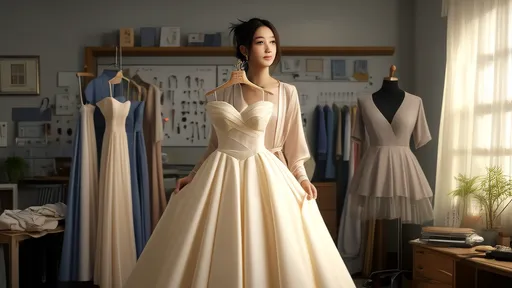
The wedding industry has long thrived on the promise of eternal love, but a new niche market is emerging from the ashes of broken vows: divorce box economics. Among the most poignant services gaining traction is wedding dress transformation—a process that allows heartbroken individuals to repurpose their once-cherished gowns into something meaningful beyond the altar. This isn’t just about recycling fabric; it’s about alchemizing grief into renewal.
The fashion industry is witnessing a seismic shift as Generation Alpha – children born between 2010 and 2024 – emerges as unexpected power players in household purchasing decisions. These digital natives, raised with tablets in their hands and influencer culture in their bloodstream, are rewriting the rules of family consumption patterns with particular dominance in apparel choices.
The luxury fashion landscape has always been a carefully curated ecosystem where price tags serve as invisible barriers between social strata. When Coach, the American leather goods brand synonymous with affordable luxury, began slashing prices across its collections, the move sent shockwaves through the industry and triggered an unexpected wave of class anxiety among its customer base.