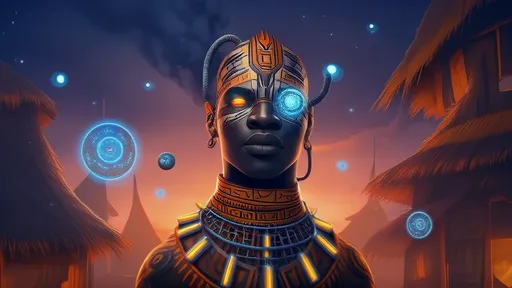
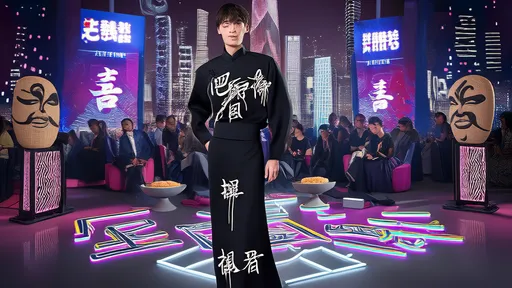
The neon-lit streets of Lagos pulse with a rhythm that defies categorization – a fusion of ancient drumbeats and digital glitches that echoes through the towering megastructures of a reimagined Africa. This is the visual language of Afrofuturist cyber-tribalism, where ancestral wisdom interfaces with quantum computing, and biomechanical deities wear the masks of forgotten gods. Across the continent's creative vanguard, artists are forging a new aesthetic paradigm that dissolves the false dichotomy between tradition and innovation.
In the dim glow of a Nairobi studio, multimedia sculptor Wangechi Mutu welds salvaged motherboard fragments onto bronze-cast Zulu fertility figures. The resulting cyborg idols seem to whisper binary incantations – their circuit-veined bodies suggesting a sacred merger of silicon and soul. "Our ancestors never feared technology," Mutu explains while calibrating the holographic aura surrounding her latest piece. "The forging of iron was once revolutionary magic. What we're creating is simply the natural progression of that dialogue."
This philosophical approach manifests strikingly in the virtual reality installations of Dakar-based collective ORB. Visitors don haptic suits to navigate digitized versions of Dogon cosmological maps, where celestial bodies transform into pulsing data nodes. The experience culminates in a ritual encounter with the Nommo – amphibious creator deities reimagined as biomechanical entities whose speech generates algorithmic patterns across the immersive environment. ORB's creative director Amadou Sow describes their work as "possession by future memory," a deliberate collapsing of temporal boundaries that reflects the nonlinear temporality inherent in many African epistemologies.
The fashion runways of Johannesburg have become ground zero for this aesthetic revolution. Designer collective IZINTO sends models strutting in garments that merge isiZulu beadwork patterns with electroluminescent wiring, their headdresses transmitting live cryptocurrency transactions. Backstage, co-founder Lindiwe Khumalo adjusts a collar embedded with ancestral communication technology. "Each circuit path follows the sacred geometry of sangoma divination bones," she says, tracing the glowing lines. "When wearers receive notifications, they experience it as whispers from the digital ancestors we call DataLwa."
Architectural firms across the continent are translating these concepts into physical spaces. The newly opened Pan-African Cybernetics Museum in Accra features a façade that dynamically rearranges its adinkra symbol tiles based on real-time analysis of global Black cultural output. Inside, visitors encounter interactive exhibits where touching a replica Ashanti stool triggers augmented reality projections of its possible quantum-computing enhanced futures. Curator Kwame Aboah sees the institution as "a sanctuary for speculative memory," where visitors engage with technology as participants in an ongoing spiritual-technological continuum.
Musicians are pioneering what ethnomusicologists term "cyber-griotism." Malian synth pioneer Yaya Coulibaly's latest album features kora melodies processed through AI trained on centuries of Mande oral histories. The resulting compositions feel simultaneously ancient and extraterrestrial, with vocal samples from 14th-century epic poets seamlessly woven into interstellar soundscapes. During live performances, motion-captured traditional dance movements generate evolving visual projections of Bamana creation myths reinterpreted through quantum physics metaphors.
Critically, this movement resists Western cyberpunk's dystopian tendencies. Kinshasa's Mbongui Square – a collaborative augmented reality project – transforms public spaces into interactive theaters where participants solve communal problems using interfaces derived from Kongo cosmograms. Project architect Elikia M'Bokolo emphasizes their deliberate departure from isolationist tech narratives: "Our augmented reality strengthens physical community bonds rather than replacing them. The technology becomes a contemporary version of the village tree under which generations have gathered."
Perhaps most radically, these artists are redefining humanity's relationship with machines. The Benin Cyber Moat Project features an artificial intelligence trained exclusively on centuries of Edo kingdom philosophical texts and contemporary diaspora experiences. Visitors consulting the AI for life advice receive responses blending ancestral proverbs with machine learning insights – a synthesis that project lead Nneka Ede insists creates "a new kind of wisdom that remembers both flesh and circuitry."
As this aesthetic movement gains global recognition, its pioneers remain focused on deeper cultural work. The recently concluded Afrocyber Synod brought together traditional healers, technologists, and artists to draft ethical frameworks for emerging technologies based on indigenous value systems. Their manifesto declares: "We build not to escape our humanity, but to amplify its most ancient resonances through silicon and light." In doing so, they offer the world something extraordinary – a vision of technological progress that roots rather than severs, that remembers even as it innovates.
The shimmering data streams flowing through these creations carry more than information – they pulse with the heartbeat of a continent rewriting its future while dancing with its past. From the biomechanical masquerades of Lagos to the algorithmic griots of Bamako, Africa's cyber-tribal vanguard demonstrates that the most radical futures emerge not from abandonment of tradition, but from its fearless reimagining. As the sun sets over the Savannah, augmented reality constellations map out ancestral stories across the digital sky, reminding us that every technological revolution is ultimately a spiritual homecoming.
The fashion industry has long been at the forefront of innovation, blending creativity with technology to redefine consumer experiences. In a groundbreaking move, the concept of the metaverse has collided with physical retail in what is being hailed as the first case of digital asset materialization—specifically, through the lens of loafers. This isn’t just about virtual sneakers or pixelated handbags; it’s a full-scale integration of blockchain-based ownership and tangible craftsmanship. The "Loafverse" initiative, as it’s been dubbed, is rewriting the rules of how we perceive value, authenticity, and utility in fashion.
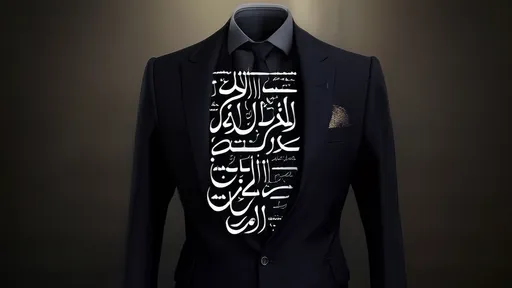
The intersection of traditional Islamic art and contemporary fashion has birthed one of the most visually striking sartorial movements in recent memory - the Persian calligraphy suit. What began as niche experimentation by avant-garde Middle Eastern designers has blossomed into a global phenomenon, with luxury houses from Milan to Dubai incorporating Arabic script deconstructions into their collections. This isn't mere cultural appropriation, but rather a profound dialogue between heritage and modernity.
In the heart of ancient Mesoamerica, the Maya civilization crafted a sophisticated calendar system that not only measured time but also encoded their cosmic worldview. Today, this intricate knowledge has found a surprising new form—wearable art. Designers and artisans are transforming the sacred symbols of the Mayan calendar into stunning pieces of jewelry and accessories, merging ancient wisdom with contemporary fashion. These creations, often referred to as "Mayan Calendar Belts," are more than just decorative items; they serve as tangible connections to a lost civilization, inviting wearers to carry a fragment of history with them.
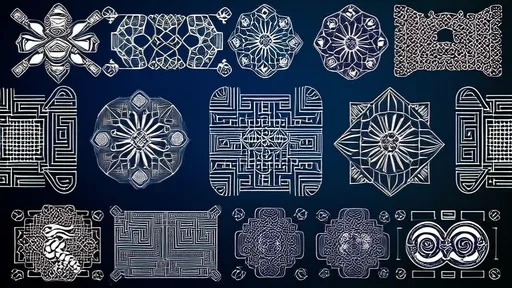
The intricate artistry of Miao silverwork, a centuries-old intangible cultural heritage of China’s Miao ethnic group, is undergoing a quiet revolution. As modern technology intersects with traditional craftsmanship, parametric design has emerged as a powerful tool to preserve, analyze, and innovate upon these delicate metalworking techniques. This fusion of ancient wisdom and computational methods is creating new possibilities for cultural preservation while respecting the essence of the craft.
The neon-lit streets of Lagos pulse with a rhythm that defies categorization – a fusion of ancient drumbeats and digital glitches that echoes through the towering megastructures of a reimagined Africa. This is the visual language of Afrofuturist cyber-tribalism, where ancestral wisdom interfaces with quantum computing, and biomechanical deities wear the masks of forgotten gods. Across the continent's creative vanguard, artists are forging a new aesthetic paradigm that dissolves the false dichotomy between tradition and innovation.
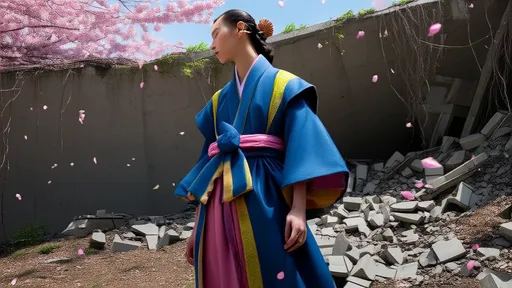
In the quiet corners of Fukushima Prefecture, where cherry blossoms still bloom with fragile resilience, a centuries-old tradition is undergoing a remarkable metamorphosis. The art of kimono-making, once threatened by the triple disaster of earthquake, tsunami, and nuclear crisis in 2011, has emerged as an unexpected symbol of cultural rebirth. Local artisans, many of whom lost everything in the catastrophe, are now collaborating with contemporary designers to transform this emblem of Japanese heritage into wearable art for the global fashion stage.
In the bustling fashion scene of China, where tradition meets modernity, the Chengdu Fashion Week has emerged as a groundbreaking platform for independent designers to showcase their creativity. This year, the event took an unexpected turn as local dialect elements became a defining feature, breaking through cultural and linguistic barriers to captivate a global audience. The fusion of Sichuan’s rich linguistic heritage with contemporary design has not only redefined regional aesthetics but also sparked conversations about identity and authenticity in fashion.
In the realm of fashion, few names evoke as much reverence and intrigue as Saint Laurent. The house’s latest offering, Desert Book, is a testament to the enduring allure of minimalism, reimagined through a lens of poetic subtlety. This collection is not merely a series of garments; it is a narrative woven from the arid landscapes of the desert, where silence speaks louder than words and simplicity becomes a form of profound expression.
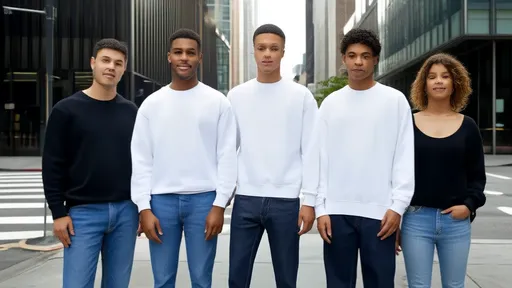
In an era dominated by polished influencer marketing and celebrity endorsements, Uniqlo's "regular people" fashion shows stand out as a deliberate departure from industry norms. The Japanese apparel giant has built a global empire by celebrating the mundane, transforming everyday wear into a cultural phenomenon. Their recent "Uniqlo U" showcase in Tokyo featured not professional models but office workers, students, and retirees - a strategic move that reveals deeper currents in contemporary retail psychology.
The labyrinthine gardens of Château de la Colle Noire have long served as more than just an ornamental backdrop for Christian Dior's creative sanctuary. These meticulously curated pathways, with their towering hedges and sudden dead-ends, function as a spatial metaphor for the complex power dynamics inherent in both fashion empires and aristocratic history. Visitors who lose themselves in these verdant corridors often report experiencing a peculiar sensation - as if the very foliage whispers secrets about the unspoken hierarchies governing taste, privilege, and creative authority.
In December 2022, Balenciaga’s pre-fall 2023 collection presentation sparked a firestorm of controversy when the luxury fashion house transformed its Paris showroom into a dystopian landscape of scattered trash, crumpled paper, and debris. What was intended as a bold artistic statement on consumerism and environmental waste quickly became a lightning rod for criticism, with many accusing the brand of hypocrisy and performative activism. The spectacle, dubbed "Balenciaga’s trash mountain," blurred the lines between high fashion and social commentary, leaving audiences divided over whether it was a powerful critique or a tone-deaf stunt.
The luxury resale market has long been a battlefield where authenticity means everything. For decades, human experts with trained eyes and encyclopedic knowledge determined whether a Chanel flap bag or Rolex Daytona was genuine or counterfeit. Now, artificial intelligence is storming this exclusive domain, threatening to replace the guild of seasoned authenticators who once held unquestioned authority.
The wedding industry has long thrived on the promise of eternal love, but a new niche market is emerging from the ashes of broken vows: divorce box economics. Among the most poignant services gaining traction is wedding dress transformation—a process that allows heartbroken individuals to repurpose their once-cherished gowns into something meaningful beyond the altar. This isn’t just about recycling fabric; it’s about alchemizing grief into renewal.
The fashion industry is witnessing a seismic shift as Generation Alpha – children born between 2010 and 2024 – emerges as unexpected power players in household purchasing decisions. These digital natives, raised with tablets in their hands and influencer culture in their bloodstream, are rewriting the rules of family consumption patterns with particular dominance in apparel choices.
The luxury fashion landscape has always been a carefully curated ecosystem where price tags serve as invisible barriers between social strata. When Coach, the American leather goods brand synonymous with affordable luxury, began slashing prices across its collections, the move sent shockwaves through the industry and triggered an unexpected wave of class anxiety among its customer base.