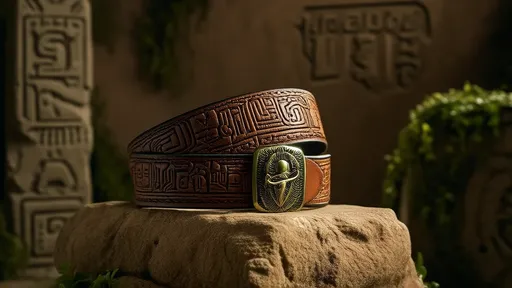
In the heart of ancient Mesoamerica, the Maya civilization crafted a sophisticated calendar system that not only measured time but also encoded their cosmic worldview. Today, this intricate knowledge has found a surprising new form—wearable art. Designers and artisans are transforming the sacred symbols of the Mayan calendar into stunning pieces of jewelry and accessories, merging ancient wisdom with contemporary fashion. These creations, often referred to as "Mayan Calendar Belts," are more than just decorative items; they serve as tangible connections to a lost civilization, inviting wearers to carry a fragment of history with them.
The Mayan calendar, particularly the Tzolk'in—a 260-day sacred cycle—has long fascinated scholars and enthusiasts alike. Its complex interlocking gears of time were not merely tools for tracking days but were deeply intertwined with Mayan spirituality, agriculture, and governance. The calendar's symbols, such as the Jaguar, the Serpent, and the Eagle, were believed to hold divine power. Modern designers have taken these symbols and reinterpreted them into belt buckles, pendants, and embroidery, creating wearable narratives that speak to both the past and the present.
The resurgence of Mayan motifs in fashion is no coincidence. In an era where cultural appreciation and sustainability are increasingly valued, these pieces offer a way to honor indigenous traditions while embracing ethical craftsmanship. Many of these belts and accessories are handmade by artisans from Mayan descendant communities, ensuring that the cultural significance is preserved and that the economic benefits flow back to these groups. The intricate beadwork, leather carving, and metal embossing techniques used in these pieces are often passed down through generations, making each item a testament to enduring craftsmanship.
One of the most striking aspects of these wearable artworks is their ability to tell a story. A belt adorned with the Glyph of the Sun might symbolize strength and vitality, while one featuring the Moon Glyph could represent intuition and the feminine divine. For those who wear them, these pieces become personal talismans, imbued with meanings that transcend mere aesthetics. Some designers even offer customization, allowing wearers to select glyphs that align with their birth dates or significant life events, further deepening the connection to the Mayan calendar's cyclical nature.
Beyond their symbolic richness, Mayan Calendar Belts have also caught the attention of the fashion world. High-end designers have begun incorporating these motifs into their collections, blending ancient symbolism with modern silhouettes. Runways from Mexico City to Paris have seen models strutting in outfits accented with Mayan glyphs, proving that these timeless designs can hold their own in the fast-paced world of fashion. This trend has sparked conversations about cultural appropriation versus appreciation, prompting many brands to collaborate directly with Mayan artisans to ensure authenticity and respect.
The appeal of these pieces lies not just in their beauty but in their ability to bridge worlds. For descendants of the Maya, wearing these symbols can be an act of cultural reclamation, a way to assert pride in a heritage that has often been marginalized. For others, it’s an opportunity to engage with a culture whose contributions to astronomy, mathematics, and art remain underrecognized. Whether worn as a statement piece or a subtle nod to history, Mayan Calendar Belts invite curiosity and dialogue, turning the wearer into a storyteller.
As interest in these artifacts grows, so does the demand for ethical production. Consumers are increasingly seeking out brands that prioritize fair trade practices and sustainable materials. Many Mayan Calendar Belts are crafted from locally sourced materials like henequen fiber, a type of agave native to Yucatán, or recycled metals. This emphasis on sustainability mirrors the Maya's own reverence for the natural world, creating a full-circle moment where ancient values inform modern choices.
In a world saturated with mass-produced accessories, Mayan Calendar Belts stand out as meaningful alternatives. They challenge us to think about the stories behind what we wear and the hands that create them. More than just fashion, they are wearable art that carries the weight of centuries—a reminder that time, as the Maya understood, is not linear but a rich tapestry of cycles and symbols waiting to be decoded.
The fashion industry has long been at the forefront of innovation, blending creativity with technology to redefine consumer experiences. In a groundbreaking move, the concept of the metaverse has collided with physical retail in what is being hailed as the first case of digital asset materialization—specifically, through the lens of loafers. This isn’t just about virtual sneakers or pixelated handbags; it’s a full-scale integration of blockchain-based ownership and tangible craftsmanship. The "Loafverse" initiative, as it’s been dubbed, is rewriting the rules of how we perceive value, authenticity, and utility in fashion.
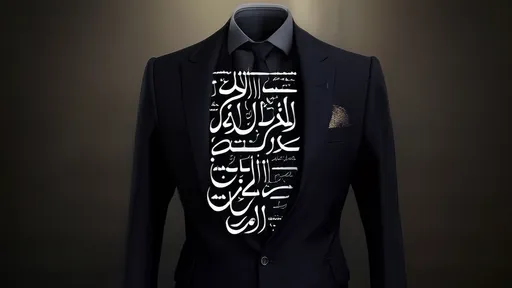
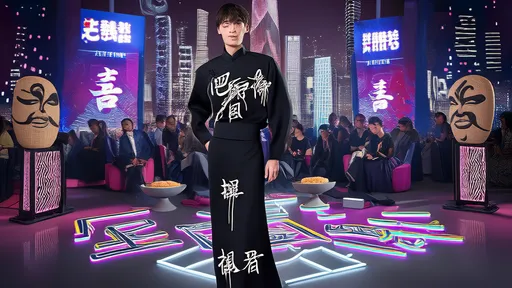
The intersection of traditional Islamic art and contemporary fashion has birthed one of the most visually striking sartorial movements in recent memory - the Persian calligraphy suit. What began as niche experimentation by avant-garde Middle Eastern designers has blossomed into a global phenomenon, with luxury houses from Milan to Dubai incorporating Arabic script deconstructions into their collections. This isn't mere cultural appropriation, but rather a profound dialogue between heritage and modernity.
In the heart of ancient Mesoamerica, the Maya civilization crafted a sophisticated calendar system that not only measured time but also encoded their cosmic worldview. Today, this intricate knowledge has found a surprising new form—wearable art. Designers and artisans are transforming the sacred symbols of the Mayan calendar into stunning pieces of jewelry and accessories, merging ancient wisdom with contemporary fashion. These creations, often referred to as "Mayan Calendar Belts," are more than just decorative items; they serve as tangible connections to a lost civilization, inviting wearers to carry a fragment of history with them.
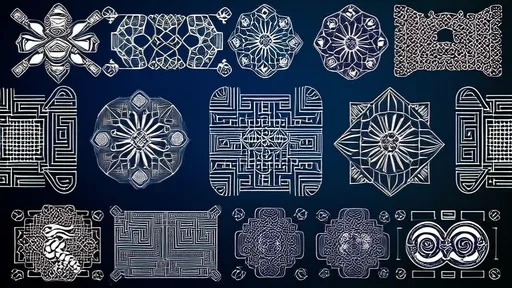
The intricate artistry of Miao silverwork, a centuries-old intangible cultural heritage of China’s Miao ethnic group, is undergoing a quiet revolution. As modern technology intersects with traditional craftsmanship, parametric design has emerged as a powerful tool to preserve, analyze, and innovate upon these delicate metalworking techniques. This fusion of ancient wisdom and computational methods is creating new possibilities for cultural preservation while respecting the essence of the craft.
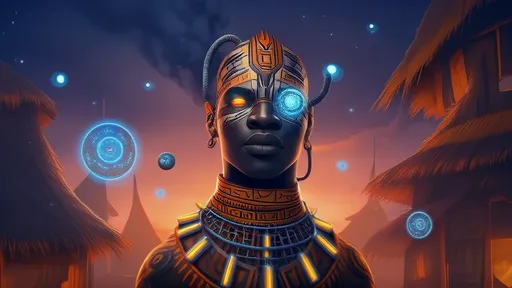
The neon-lit streets of Lagos pulse with a rhythm that defies categorization – a fusion of ancient drumbeats and digital glitches that echoes through the towering megastructures of a reimagined Africa. This is the visual language of Afrofuturist cyber-tribalism, where ancestral wisdom interfaces with quantum computing, and biomechanical deities wear the masks of forgotten gods. Across the continent's creative vanguard, artists are forging a new aesthetic paradigm that dissolves the false dichotomy between tradition and innovation.
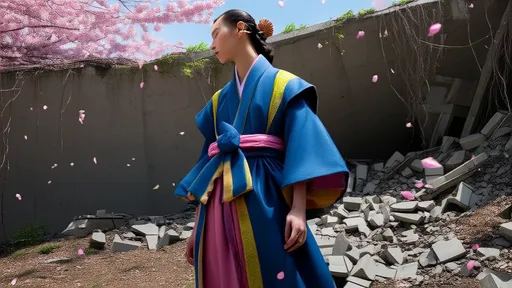
In the quiet corners of Fukushima Prefecture, where cherry blossoms still bloom with fragile resilience, a centuries-old tradition is undergoing a remarkable metamorphosis. The art of kimono-making, once threatened by the triple disaster of earthquake, tsunami, and nuclear crisis in 2011, has emerged as an unexpected symbol of cultural rebirth. Local artisans, many of whom lost everything in the catastrophe, are now collaborating with contemporary designers to transform this emblem of Japanese heritage into wearable art for the global fashion stage.
In the bustling fashion scene of China, where tradition meets modernity, the Chengdu Fashion Week has emerged as a groundbreaking platform for independent designers to showcase their creativity. This year, the event took an unexpected turn as local dialect elements became a defining feature, breaking through cultural and linguistic barriers to captivate a global audience. The fusion of Sichuan’s rich linguistic heritage with contemporary design has not only redefined regional aesthetics but also sparked conversations about identity and authenticity in fashion.
In the realm of fashion, few names evoke as much reverence and intrigue as Saint Laurent. The house’s latest offering, Desert Book, is a testament to the enduring allure of minimalism, reimagined through a lens of poetic subtlety. This collection is not merely a series of garments; it is a narrative woven from the arid landscapes of the desert, where silence speaks louder than words and simplicity becomes a form of profound expression.
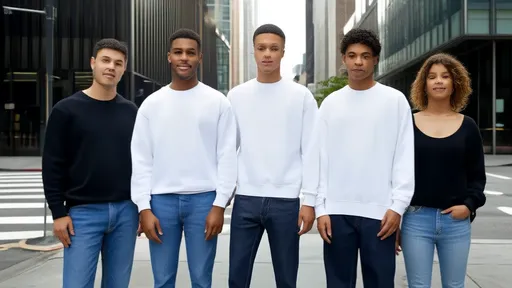
In an era dominated by polished influencer marketing and celebrity endorsements, Uniqlo's "regular people" fashion shows stand out as a deliberate departure from industry norms. The Japanese apparel giant has built a global empire by celebrating the mundane, transforming everyday wear into a cultural phenomenon. Their recent "Uniqlo U" showcase in Tokyo featured not professional models but office workers, students, and retirees - a strategic move that reveals deeper currents in contemporary retail psychology.
The labyrinthine gardens of Château de la Colle Noire have long served as more than just an ornamental backdrop for Christian Dior's creative sanctuary. These meticulously curated pathways, with their towering hedges and sudden dead-ends, function as a spatial metaphor for the complex power dynamics inherent in both fashion empires and aristocratic history. Visitors who lose themselves in these verdant corridors often report experiencing a peculiar sensation - as if the very foliage whispers secrets about the unspoken hierarchies governing taste, privilege, and creative authority.
In December 2022, Balenciaga’s pre-fall 2023 collection presentation sparked a firestorm of controversy when the luxury fashion house transformed its Paris showroom into a dystopian landscape of scattered trash, crumpled paper, and debris. What was intended as a bold artistic statement on consumerism and environmental waste quickly became a lightning rod for criticism, with many accusing the brand of hypocrisy and performative activism. The spectacle, dubbed "Balenciaga’s trash mountain," blurred the lines between high fashion and social commentary, leaving audiences divided over whether it was a powerful critique or a tone-deaf stunt.
The luxury resale market has long been a battlefield where authenticity means everything. For decades, human experts with trained eyes and encyclopedic knowledge determined whether a Chanel flap bag or Rolex Daytona was genuine or counterfeit. Now, artificial intelligence is storming this exclusive domain, threatening to replace the guild of seasoned authenticators who once held unquestioned authority.
The wedding industry has long thrived on the promise of eternal love, but a new niche market is emerging from the ashes of broken vows: divorce box economics. Among the most poignant services gaining traction is wedding dress transformation—a process that allows heartbroken individuals to repurpose their once-cherished gowns into something meaningful beyond the altar. This isn’t just about recycling fabric; it’s about alchemizing grief into renewal.
The fashion industry is witnessing a seismic shift as Generation Alpha – children born between 2010 and 2024 – emerges as unexpected power players in household purchasing decisions. These digital natives, raised with tablets in their hands and influencer culture in their bloodstream, are rewriting the rules of family consumption patterns with particular dominance in apparel choices.
The luxury fashion landscape has always been a carefully curated ecosystem where price tags serve as invisible barriers between social strata. When Coach, the American leather goods brand synonymous with affordable luxury, began slashing prices across its collections, the move sent shockwaves through the industry and triggered an unexpected wave of class anxiety among its customer base.