The labyrinthine gardens of Château de la Colle Noire have long served as more than just an ornamental backdrop for Christian Dior's creative sanctuary. These meticulously curated pathways, with their towering hedges and sudden dead-ends, function as a spatial metaphor for the complex power dynamics inherent in both fashion empires and aristocratic history. Visitors who lose themselves in these verdant corridors often report experiencing a peculiar sensation - as if the very foliage whispers secrets about the unspoken hierarchies governing taste, privilege, and creative authority.
At dusk, when shadows stretch across the gravel paths like elongated fingers, the maze appears to shift its configuration. This optical illusion speaks volumes about the mutable nature of influence within luxury conglomerates. The central courtyard, with its ancient stone fountain, becomes a stage where sunlight and shadow perform their daily ballet - much like the delicate interplay between artistic vision and commercial imperatives that defines modern fashion houses. Historical records suggest Dior himself would pace these routes when wrestling with collection concepts, allowing the physical act of navigation to untangle creative knots.
Archival correspondence reveals how postwar reconstruction efforts influenced the garden's current layout. The original 19th-century design, with its straightforward radial pattern, gave way to more convoluted pathways during the 1950s renovations - precisely when Dior's New Look was revolutionizing feminine silhouettes. This parallel between spatial and sartorial complexity invites closer examination. The maze doesn't merely represent power; it performs it through deliberate disorientation, teaching visitors through embodied experience how prestige operates through controlled revelation and strategic concealment.
Botanical choices further reinforce this narrative. Rosemary hedges, traditionally associated with remembrance, flank sections containing the original atelier structures. Their persistent fragrance serves as an olfactory anchor to the house's origins, even as the path forward remains obscured. Meanwhile, sudden clearings showcase contemporary sculpture installations - abrupt juxtapositions that mirror how heritage brands must negotiate between tradition and innovation. Horticulturalists note how the boxwood varieties were selected for their responsiveness to topiary, allowing the maze to literally reshape itself over time while maintaining essential structure.
The maze's most cunning feature might be its false perspectives. Certain alleys appear to lead directly to the château's main entrance, only to curve away at the last moment. Others promise secluded benches that vanish when approached. These architectural sleights-of-hand find their counterpart in fashion's seasonal cycles, where apparent transparency about creative processes often masks deeper strategic calculations. During important collection previews, guests report being guided along specific routes that frame particular views of the property - a literal staging of access that mirrors the carefully managed revelation of designs to different market tiers.
Recent conservation work uncovered original blueprints showing abandoned maze extensions that would have connected directly to the textile archives. This unrealized plan suggests an even more profound physical manifestation of the creative process - where raw materials might have flowed through the landscape itself. The current archivist has noted how sunlight penetrates the hedge walls at precise angles during equinoxes, illuminating certain artifacts in the adjacent museum wing. Whether intentional or serendipitous, this phenomenon underscores how the maze continues to exert influence over how the Dior legacy gets viewed, quite literally.
Night tours reveal another layer of meaning. Under carefully positioned lighting, the maze's western quadrant casts shadows that precisely recreate the iconic Bar suit silhouette across adjacent lawns. This ephemeral nightly performance, lasting exactly 22 minutes (the average time needed to construct the suit's famous hip padding), demonstrates how spatial narratives can transcend physical boundaries. The effect intensifies during full moons, when multiple sartorial shadows appear to converse across the grounds - a silent symposium of Dior's most revolutionary designs.
Contemporary artists invited to intervene in the space frequently remark on the maze's acoustic properties. The hedge height and density create sound channels that carry whispers nearly 100 meters, while completely muffling voices just a few paces off the main path. This auditory dimension adds yet another metaphor for the fashion industry's complex information economies, where crucial intelligence often travels through unexpected channels while official communications remain carefully modulated. The current creative director has been known to hold walk-and-talk meetings in the maze's outermost ring, using the environment's natural sound baffling to ensure discretion.
As climate change alters growing patterns, the maze has begun developing intriguing anomalies. Certain sections now require trimming schedules that contradict their historical rhythms, resulting in unexpected gaps and densities. Gardeners have adopted an adaptive approach, allowing the living structure to express these changes rather than forcing conformity. This organic evolution mirrors how luxury houses must now navigate shifting cultural landscapes - maintaining recognizable codes while accommodating new realities. The maze, in this sense, has become an unwitting chronicle of our times, its very foliage recording atmospheric changes much like tree rings document centuries.
The upcoming exhibition "Mirrored Paths" will install antique looking-glasses at key turning points, creating infinite reflections that fracture and multiply the visitor's image. This intervention promises to literalize the maze's longstanding function as a space for confronting multiple selves - the public persona versus private identity, the creative visionary versus business strategist. Early mockups suggest the mirrors will align at certain hours to create a tunnel effect, visually extending pathways far beyond their physical limits. It's a fitting metaphor for how Dior's influence continues to propagate through time and space, far exceeding the boundaries of any single garden or garment.
The fashion industry has long been at the forefront of innovation, blending creativity with technology to redefine consumer experiences. In a groundbreaking move, the concept of the metaverse has collided with physical retail in what is being hailed as the first case of digital asset materialization—specifically, through the lens of loafers. This isn’t just about virtual sneakers or pixelated handbags; it’s a full-scale integration of blockchain-based ownership and tangible craftsmanship. The "Loafverse" initiative, as it’s been dubbed, is rewriting the rules of how we perceive value, authenticity, and utility in fashion.
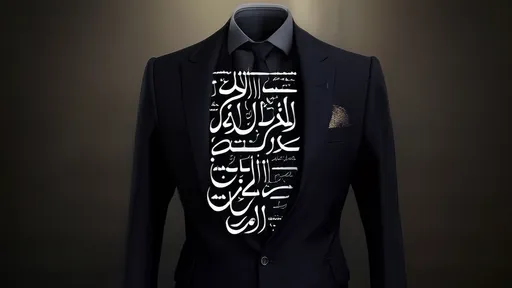
The intersection of traditional Islamic art and contemporary fashion has birthed one of the most visually striking sartorial movements in recent memory - the Persian calligraphy suit. What began as niche experimentation by avant-garde Middle Eastern designers has blossomed into a global phenomenon, with luxury houses from Milan to Dubai incorporating Arabic script deconstructions into their collections. This isn't mere cultural appropriation, but rather a profound dialogue between heritage and modernity.
In the heart of ancient Mesoamerica, the Maya civilization crafted a sophisticated calendar system that not only measured time but also encoded their cosmic worldview. Today, this intricate knowledge has found a surprising new form—wearable art. Designers and artisans are transforming the sacred symbols of the Mayan calendar into stunning pieces of jewelry and accessories, merging ancient wisdom with contemporary fashion. These creations, often referred to as "Mayan Calendar Belts," are more than just decorative items; they serve as tangible connections to a lost civilization, inviting wearers to carry a fragment of history with them.
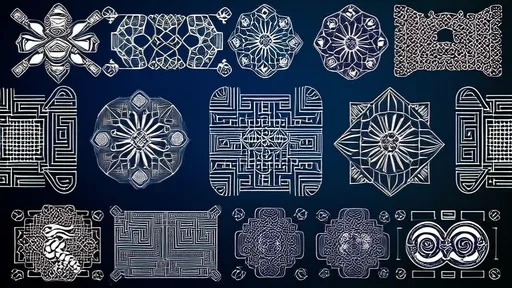
The intricate artistry of Miao silverwork, a centuries-old intangible cultural heritage of China’s Miao ethnic group, is undergoing a quiet revolution. As modern technology intersects with traditional craftsmanship, parametric design has emerged as a powerful tool to preserve, analyze, and innovate upon these delicate metalworking techniques. This fusion of ancient wisdom and computational methods is creating new possibilities for cultural preservation while respecting the essence of the craft.
The neon-lit streets of Lagos pulse with a rhythm that defies categorization – a fusion of ancient drumbeats and digital glitches that echoes through the towering megastructures of a reimagined Africa. This is the visual language of Afrofuturist cyber-tribalism, where ancestral wisdom interfaces with quantum computing, and biomechanical deities wear the masks of forgotten gods. Across the continent's creative vanguard, artists are forging a new aesthetic paradigm that dissolves the false dichotomy between tradition and innovation.
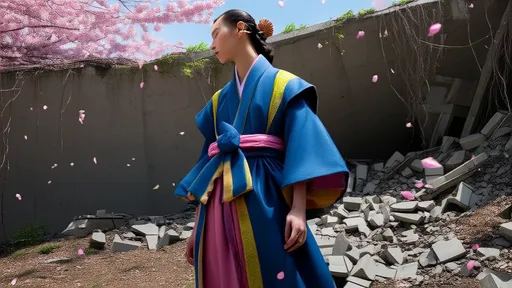
In the quiet corners of Fukushima Prefecture, where cherry blossoms still bloom with fragile resilience, a centuries-old tradition is undergoing a remarkable metamorphosis. The art of kimono-making, once threatened by the triple disaster of earthquake, tsunami, and nuclear crisis in 2011, has emerged as an unexpected symbol of cultural rebirth. Local artisans, many of whom lost everything in the catastrophe, are now collaborating with contemporary designers to transform this emblem of Japanese heritage into wearable art for the global fashion stage.
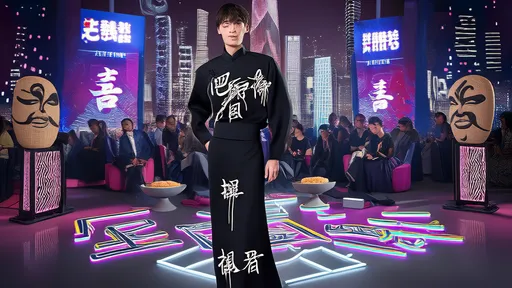
In the bustling fashion scene of China, where tradition meets modernity, the Chengdu Fashion Week has emerged as a groundbreaking platform for independent designers to showcase their creativity. This year, the event took an unexpected turn as local dialect elements became a defining feature, breaking through cultural and linguistic barriers to captivate a global audience. The fusion of Sichuan’s rich linguistic heritage with contemporary design has not only redefined regional aesthetics but also sparked conversations about identity and authenticity in fashion.
In the realm of fashion, few names evoke as much reverence and intrigue as Saint Laurent. The house’s latest offering, Desert Book, is a testament to the enduring allure of minimalism, reimagined through a lens of poetic subtlety. This collection is not merely a series of garments; it is a narrative woven from the arid landscapes of the desert, where silence speaks louder than words and simplicity becomes a form of profound expression.
In an era dominated by polished influencer marketing and celebrity endorsements, Uniqlo's "regular people" fashion shows stand out as a deliberate departure from industry norms. The Japanese apparel giant has built a global empire by celebrating the mundane, transforming everyday wear into a cultural phenomenon. Their recent "Uniqlo U" showcase in Tokyo featured not professional models but office workers, students, and retirees - a strategic move that reveals deeper currents in contemporary retail psychology.
The labyrinthine gardens of Château de la Colle Noire have long served as more than just an ornamental backdrop for Christian Dior's creative sanctuary. These meticulously curated pathways, with their towering hedges and sudden dead-ends, function as a spatial metaphor for the complex power dynamics inherent in both fashion empires and aristocratic history. Visitors who lose themselves in these verdant corridors often report experiencing a peculiar sensation - as if the very foliage whispers secrets about the unspoken hierarchies governing taste, privilege, and creative authority.
In December 2022, Balenciaga’s pre-fall 2023 collection presentation sparked a firestorm of controversy when the luxury fashion house transformed its Paris showroom into a dystopian landscape of scattered trash, crumpled paper, and debris. What was intended as a bold artistic statement on consumerism and environmental waste quickly became a lightning rod for criticism, with many accusing the brand of hypocrisy and performative activism. The spectacle, dubbed "Balenciaga’s trash mountain," blurred the lines between high fashion and social commentary, leaving audiences divided over whether it was a powerful critique or a tone-deaf stunt.
The luxury resale market has long been a battlefield where authenticity means everything. For decades, human experts with trained eyes and encyclopedic knowledge determined whether a Chanel flap bag or Rolex Daytona was genuine or counterfeit. Now, artificial intelligence is storming this exclusive domain, threatening to replace the guild of seasoned authenticators who once held unquestioned authority.
The wedding industry has long thrived on the promise of eternal love, but a new niche market is emerging from the ashes of broken vows: divorce box economics. Among the most poignant services gaining traction is wedding dress transformation—a process that allows heartbroken individuals to repurpose their once-cherished gowns into something meaningful beyond the altar. This isn’t just about recycling fabric; it’s about alchemizing grief into renewal.
The fashion industry is witnessing a seismic shift as Generation Alpha – children born between 2010 and 2024 – emerges as unexpected power players in household purchasing decisions. These digital natives, raised with tablets in their hands and influencer culture in their bloodstream, are rewriting the rules of family consumption patterns with particular dominance in apparel choices.
The luxury fashion landscape has always been a carefully curated ecosystem where price tags serve as invisible barriers between social strata. When Coach, the American leather goods brand synonymous with affordable luxury, began slashing prices across its collections, the move sent shockwaves through the industry and triggered an unexpected wave of class anxiety among its customer base.